
Abdul Aziz Haqqani, a top leader of Pakistan-based dreaded Haqqani network, has been named 'Specially Designated Global Terrorist' by the United States for his involvement in planning and carrying out attacks against Afghanistan.
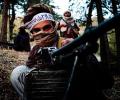
The United States has announced a bounty of $30 million for information leading to the location of five key leaders of the Haqqani militant network, held responsible for several attacks on civilians and NATO forces in Afghanistan.

Aziz Haniffa finds out why few people are upset about the Pakistani ambassador's ouster and what the outlook on his successor is.

Noted American experts and analysts argue that Foreign Terrorist Organisation designation of the Haqqani Network is meaningless unless Pakistan's intelligence agency is reined it. Aziz Haniffa reports
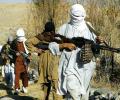
Pakistan National Security Advisor Sartaj Aziz brings to New Delhi a newfound Pakistani confidence, stemming from its leverage in Afghanistan, says Ajai Shukla

'Perhaps the biggest indication was its striking decision in November to delink LeT from its aid certification process.' 'The administration decided that the US, in order to send military aid to Pakistan, would not need to certify that Pakistan is cracking down on LeT.' 'Perhaps the administration was trying to offer a carrot -- in effect, we're backing off on LeT, but in return we expect you (Pakistan) to go after the Haqqanis.' 'Either way, the optics were dreadful for the US given that Hafiz Saeed was released from house arrest a few days after the US move.' 'The US reacted angrily, but eventually it moved on, and refocused on its core concern: The Afghan-focused terror groups.'

The United States has said that the threat from terrorist groups, in particular the Haqqani network, continues to emanate from inside Pakistan, dismissing top Pakistani diplomat's claim that the dreaded group responsible for audacious attacks in Afghanistan has been wiped out.

Aziz said that Pakistan-US relations had come to a standstill in 2011 because of incidents of WikiLeaks, Raymond Davis, Abbottabad operation, Datta Khel and Salala.
Mansoor Ijaz, the man who has triggered off a political crisis in Pakistan, is a 'dubious character,' who is sowing 'seeds of dissension,' South Asia experts in the US tell Aziz Haniffa in Washington, DC.
At least eight persons, including three Haqqani network commanders, were killed on Thursday in a rare United States drone strike outside Pakistan's tribal belt, just a day after a top official said the US had agreed to halt such attacks during negotiations with militants.

Defence Secretary Mattis said he cannot certify that Islamabad has taken 'sufficient actions' against the dreaded Haqqani terror network.
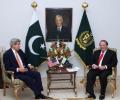
US Secretary of State John Kerry during his visit to Pakistan addressed the issue of terrorism and also called on both - India and Pakistan to find a diplomatic solution to the violence at the border issue.
Pak-US ties are sliding down the hill due to difference over handling of peace issue in Afghanistan and US' growing defence tie with India.
When then ISI director Lieutenant General Ahmad Shuja Pasha visited Washington, DC for a meeting with CIA Director Michael Hayden, he admitted that the planners of the Mumbai attacks included some 'retired Pakistani officers' and that the attackers had 'ISI links, but this had not been an authorised ISI operation.'
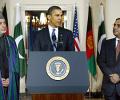
'The real purpose of President Obama writing to President Zardari,' Husain Haqqani tells Rediff.com's Aziz Haniffa, 'was to seek a turnaround on terrorism -- that Pakistan, whatever its grievances, cannot have jihadi groups operating openly on its soil.'
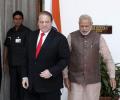
India'Prime Minister Narendra Modi has been congratulated for his speedy diplomacy and his talks with Pakistani counterpart Nawaz Sharif. However, academic Christine Fair and former Pakistan ambassador to US Husain Haqqani dismiss the meeting, calling it merely a photo-op and an exercise in futility. Aziz Haniffa reports.

'Bolstering India's conventional military capability against China is in America's strategic interest,' says military historian Colonel Anil A Athale (retd).
'We think Pakistan has moved decisively against terrorists that threaten Pakistan internally, but still needs to devote attention to those that represent a threat to their neighbours.'

Following the row over financing, Pakistan seems to have failed to seal the deal for the purchase of eight F-16 fighter jets from the United States.
'Just this week, the Indians killed a Kashmiri terrorist, who is a member of Hizbul Mujahideen.' 'This is a nasty terrorist organisation, and did Pakistan welcome this killing?' 'No, in fact, they denounced it and referred to him as a Kashmiri separatist.' 'These Kashmiri terrorist groups have been aided by the Pakistani State.'

'Pakistanis are very clever in manipulating us,' former Bush administration official tells US lawmakers.

'The clique that runs that country is treating us like suckers. We are very foolish, giving people money who involve themselves in activity that's harmful to America.' 'When you look at the cold hard facts, Pakistan is not an ally to the United States. They have facilitated, they have encouraged, they have been a protector of enemies.'

'The ISI has given a stunning display of its capacity to do with impunity what it likes within Kabul. Incensed over the triumphalism of the hardliners in Kabul, the ISI has hit out; it is a typical ISI reflex action that Indians are familiar with,' says Ambassador M K Bhadrakumar.
India must watch for signs after Peshawar that Pakistan is waking up to the dangers of Islamism, muses Ajai Shukla
A White House official said the US is prepared to take actions on its own to safeguard its personnel in Afghanistan.
Through its early days to the 1980s, Pakistan sought to expand its sphere of Islamic influence through Afghanistan to Central Asia and got Pakistani citizens recruited in the Afghan government institutions in the 1990s when the Taliban were power. Now, it is looking eastward through India to Bangladesh and Myanmar to establish an imaginary caliphate.

'I believe one of the most critical issues is the common threat we face from Islamist radicals and the continuing and unimpaired financing of Al Qaeda, the 'D' Company, the Haqqani network, the LeT and the Jaish-e-Muhammed.'
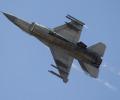
Diplomatic and Congressional sources tell Rediff.com that for all intents and purposes, the F-16 sale is dead.

'The Senators were playing safe, not angering either the pro-India lobby or the pro-Pakistan lobby, but perhaps more importantly, the military-industrial complex -- the most powerful lobby of all -- which the majority of Senators are beholden to in terms of largesse to their campaign coffers.'
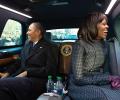
US President Barack Obama told Prime Minister Narendra Modi, when the two met on the sidelines of the East Asia Summit in Myanmar in November 2014, how he barely had two years left to his presidential term and so much to do. The wish list included getting his daughters to see a tiger in the wild and the Taj Mahal.

Senator John Cornyn, founder and Republican co-chair of the Senate India Caucus, strongly defends his vote against a resolution to block sale of American-made F-16s to Pakistan.

Immediately after India launched its surgical strikes, sources said, it had informed the US of its action.

What India has failed to acknowledge is that sub-conventional war is the name of the game and irregular forces have emerged with greater strategic value over conventional and even nuclear forces, and reliance purely on conventional force and diplomacy is grossly inadequate, says Lt Gen Prakash Katoch (retired).

A grieving Pakistan's policy shift towards the Taliban has comes at a great cost, says Shahzad Raza.

'What is the ISI doing and why can't they understand for their own interest that bringing stability to the region will help all the countries become prosperous, whereas a continuation of incitement will only lead to misery for all.'

'Diplomatic engagement will continue even as India keeps all its options open with respect to discretely targeting the Pakistani military and its terrorist proxies.'
 © 2026 Rediff.com - Advertise with us - Disclaimer - Privacy Policy - Sitemap - Feedback - About us - Terms of use - Grievances